Εμφάνιση αναρτήσεων με ετικέτα History. Εμφάνιση όλων των αναρτήσεων

Δευτέρα 16 Φεβρουαρίου 2015

Body Combat-Χαστε θερμιδες παλεύοντας!

Body Combat: Κάψτε 737 θερμίδες... παλεύοντας

Όταν οι πολεμικές τέχνες συνάντησαν το αερόμπικ και το χορό, τότε δημιουργήθηκε ένα είδος προπόνησης που υπόσχεται πολλά: σφριγηλό κορμί, αυτοπεποίθηση και άφθονες στιγμές διασκέδασης.

Body Combat: Κάψτε 737 θερμίδες... παλεύοντας
Ένα εκρηκτικό καρδιοτονωτικό πρόγραμμα, που παντρεύει δημιουργικά και αποτελεσματικά το αερόμπικ με τις πολεμικές τέχνες, είναι το Body Combat. Η μέθοδος, που φέρει την υπογραφή της πρώην αθλήτριας των Ολυμπιακών Αγώνων Λες Μιλς, κερδίζει συνεχώς έδαφος, αποκτώντας πολλούς οπαδούς σε πολλές χώρες όπου γίνεται, ανάμεσά τους και η Ελλάδα. Δεν είναι τυχαίο, αφού υπόσχεται πολλαπλά οφέλη: εκτόνωση, απώλεια βάρους, σμιλεμένους μυς, ευλυγισία, καλύτερη στάση του σώματος, αύξηση της οστικής πυκνότητας, αλλά και αυτοπεποίθηση.

Πέρα από τις κλοτσιές και τις μπουνιές που θα σας εκτονώσουν και φυσικά θα σας γυμνάσουν, θα μάθετε και τις βασικές αρχές της αυτοάμυνας. Απαραίτητη προϋπόθεση, βέβαια, είναι να αφεθείτε στη μαγεία του χορού, αλλά και να προσπαθήσετε να εκτελείτε κάθε άσκηση με συγκέντρωση και πειθαρχία. Εκτός όμως από τη σκληρή προπόνηση, η δυνατή μουσική –απαραίτητο συστατικό του Body Combat- θα σας φτιάξει τη διάθεση.
Σύμφωνα με τους trainers, το καλύτερο είναι ότι σε ένα μόνο μάθημα, διάρκειας 55', θα κάψετε 737 θερμίδες, αλλά και θα καταφέρετε να βγάλετε την αμαζόνα που κρύβετε μέσα σας

Lose weight-easy tips

How to Lose Weight: 40 Fast, Easy Tips

You know the drill when it comes to losing weight: take in fewer calories, burn more calories. But you also know that most diets and quick weight-loss plans don't work as promised. If you're trying to drop a few pounds fast, these expert tips will make it easy for you to lose the weight quickly.
lose weight
1. Write down what you eat for one week and you will lose weight. Studies found that people who keep food diaries wind up eating about 15 percent less food than those who don’t. Watch out for weekends: A University of North Carolina study found people tend to consume an extra 115 calories per weekend day, primarily from alcohol and fat. Then cut out or down calories from spreads, dressings, sauces, condiments, drinks, and snacks; they could make the difference between weight gain and loss.
2. Add 10 percent to the amount of daily calories you think you’re eating. If you think you’re consuming 1,700 calories a day and don’t understand why you’re not losing weight, add another 170 calories to your guesstimate. Chances are, the new number is more accurate. Adjust your eating habits accordingly.
3. Get an online weight loss buddy to lose more weight. A University of Vermont study found that online weight-loss buddies help you keep the weight off. The researchers followed volunteers for 18 months. Those assigned to an Internet-based weight maintenance program sustained their weight loss better than those who met face-to-face in a support group.
4. Get a mantra.
You’ve heard of a self-fulfilling prophecy? If you keep focusing on things you can’t do, like resisting junk food or getting out the door for a daily walk, chances are you won’t do them. Instead (whether you believe it or not) repeat positive thoughts to yourself. “I can lose weight.” “I will get out for my walk today.” “I know I can resist the pastry cart after dinner.” Repeat these phrases and before too long, they will become true for you.

foods that prevent wrinkles water5. After breakfast, stick to water.
At breakfast, go ahead and drink orange juice. But throughout the rest of the day, focus on water instead of juice or soda. The average American consumes an extra 245 calories a day from soft drinks. That’s nearly 90,000 calories a year—or 25 pounds! And research shows that despite the calories, sugary drinks don’t trigger a sense of fullness the way that food does.
6. Eat three fewer bites of your meal,
one less treat a day, or one less glass of orange juice. Doing any of these can save you about 100 calories a day, and that alone is enough to prevent you from gaining the two pounds most people mindlessly pack on each year.
7. Watch one less hour of TV.
A study of 76 undergraduate students found the more they watched television, the more often they ate and the more they ate overall. Sacrifice one program (there’s probably one you don’t really want to watch anyway) and go for a walk instead.
8. Wash something thoroughly once a week.
Whether that’s a floor, a couple of windows, the shower stall, bathroom tile, or your car, a 150-pound person will burn about four calories for every minute spent cleaning. Scrub for 30 minutes and you could work off approximately 120 calories, the same number in a half-cup of vanilla frozen yogurt.
9. Wait until your stomach rumbles before you reach for food.
It’s stunning how often we eat out of boredom, nervousness, habit, or frustration—so often, in fact, that many of us have actually forgotten what physical hunger feels like. If you’re hankering for a specific food, it’s probably a craving, not hunger. If you’d eat anything you could get your hands on, chances are you’re truly hungry. Find ways other than eating to express love, tame stress, and relieve boredom.

crazy weight loss tips, smell some fruit10. Sniff a banana, an apple, or a peppermint when you feel hungry.
You might feel silly, but it works. When Alan R. Hirsch, M.D., neurological director of the Smell & Taste Treatment and Research Foundation in Chicago, tried this with 3,000 volunteers, he found that the more frequently people sniffed, the less hungry they were and the more weight they lost—an average of 30 pounds each. One theory is that sniffing the food tricks the brain into thinking you’re actually eating it.
11. Stare at the color blue.
There’s a good reason you won’t see many fast-food restaurants decorated in blue: it functions as an appetite suppressant. So serve up dinner on blue plates, dress in blue while you eat, and cover your table with a blue tablecloth. Conversely, avoid red, yellow, and orange in your dining areas. Studies find they encourage eating.
12. Eat in front of mirrors and you’ll lose weight.
One study found that eating in front of mirrors slashed the amount people ate by nearly one-third. Having to look yourself in the eye reflects back some of your own inner standards and goals, and reminds you of why you’re trying to lose weight in the first place.
13. Spend 10 minutes a day walking up and down stairs.
The Centers for Disease Control says that’s all it takes to help you shed as much as 10 pounds a year (assuming you don’t start eating more).
14. Walk five minutes for at least every two hours.
Stuck at a desk all day? A brisk five-minute walk every two hours will parlay into an extra 20-minute walk by the end of the day. And getting a break will make you less likely to reach for snacks out of antsiness.
15. You’ll lose weight and fat if you walk 45 minutes a day, not 30.
The reason we’re suggesting 45 minutes instead of the typical 30 is that a Duke University study found that while 30 minutes of daily walking is enough to prevent weight gain in most relatively sedentary people, exercise beyond 30 minutes results in weight and fat loss. Burning an additional 300 calories a day with three miles of brisk walking (45 minutes should do it) could help you lose 30 pounds in a year without even changing how much you’re eating.

eat-better-spend-less-store-brands-sl16. Don’t buy any prepared food
that lists sugar, fructose, or corn syrup among the first four ingredients on the label. You should be able to find a lower-sugar version of the same type of food. If you can’t, grab a piece of fruit instead! Look for sugar-free varieties of foods such as ketchup, mayonnaise, and salad dressing. Also, avoid partially hydrogenated foods, and look for more than two grams of fiber per 100 calories in all grain products. Finally, a short ingredient list means fewer flavor enhancers and empty calories.
17. Put your fork or spoon down between every bite.
At the table, sip water frequently. Intersperse your eating with stories for your dining partner of the amusing things that happened during your day. Your brain lags your stomach by about 20 minutes when it comes to satiety (fullness) signals. If you eat slowly enough, your brain will catch up to tell you that you are no longer in need of food.
18. Throw out your “fat” clothes for good.
Once you’ve started losing weight, throw out or give away every piece of clothing that doesn’t fit. The idea of having to buy a whole new wardrobe if you gain the weight back will serve as a strong incentive to stay fit.
19. Close the kitchen for 12 hours.
After dinner, wash all the dishes, wipe down the counters, turn out the light, and, if necessary, tape closed the cabinets and refrigerator. Late-evening eating significantly increases the overall number of calories you eat, a University of Texas study found. Stopping late-night snacking can save 300 or more calories a day, or 31 pounds a year.
20. Walk before dinner and you’ll cut calories AND your appetite.
In a study of 10 obese women conducted at the University of Glasgow in Scotland, 20 minutes of walking reduced appetite and increased sensations of fullness as effectively as a light meal.

walk-outside-sl21. Make one social outing this week an active one.
Pass on the movies and screen the views of a local park instead. Not only will you sit less, but you’ll be saving calories because you won’t chow down on that bucket of popcorn. Other active ideas: a tennis match, a guided nature or city walk (check your local listings), a bike ride, or bowling.
22. Buy a pedometer, clip it to your belt, and aim for an extra 1,000 steps a day.
On average, sedentary people take only 2,000 to 3,000 steps a day. Adding 2,000 steps will help you maintain your current weight and stop gaining weight; adding more than that will help you lose weight.
23. Put less food out and you’ll take less in.
Conversely, the more food in front of you, the more you’ll eat—regardless of how hungry you are. So instead of using regular dinner plates that range these days from 10 to 14 inches (making them look empty if they’re not heaped with food), serve your main course on salad plates (about 7 to 9 inches wide). Instead of 16-ounce glasses and oversized coffee mugs, return to the old days of 8-ounce glasses and 6-ounce coffee cups.
24. Eat 90 percent of your meals at home.
You’re more likely to eat more—and eat more high-fat, high-calorie foods—when you eat out than when you eat at home. Restaurants today serve such large portions that many have switched to larger plates and tables to accommodate them.

healthy-changes-lean-portion-01-ss25. Serve food on your plate instead of on platters.
If you eat your dinner restaurant style on your plate rather than family style, helping yourself from bowls and platters on the table, you’ll lose weight. Most of us tend to eat an average of 150 percent more calories in the evening than in the morning. You’ll avoid that now because when your plate is empty, you’re finished; there’s no reaching for seconds.
26. Don’t eat with a large group.
A study published in the Journal of Physiological Behavior found that we tend to eat more when we eat with other people, most likely because we spend more time at the table. But eating with your significant other or your family, and using table time for talking in between chewing, can help cut down on calories.
27. Order the smallest portion of everything.
If you’re out and ordering a sub, get the 6-inch sandwich. Buy a small popcorn, a small salad, a small hamburger. Again, studies find we tend to eat what’s in front of us, even though we’d feel just as full on less.
28. Eat water-rich foods and you’ll eat fewer calories overall.
A body of research out of Pennsylvania State University finds that eating water-rich foods such as zucchini, tomatoes, and cucumbers during meals reduces your overall calorie consumption. Other water-rich foods include soups and salads. You won’t get the same benefits by just drinking your water, though. Because the body processes hunger and thirst through different mechanisms, it simply doesn’t register a sense of fullness with water (or soda, tea, coffee, or juice).
29. Bulk up your meals with veggies.
You can eat twice as much pasta salad loaded with veggies like broccoli, carrots, and tomatoes for the same calories as a pasta salad sporting just mayonnaise. Same goes for stir-fries, omelets, and other veggie-friendly dishes. If you eat a 1:1 ratio of grains to veggies, the high-fiber veggies will help satisfy your hunger before you overeat the grains.
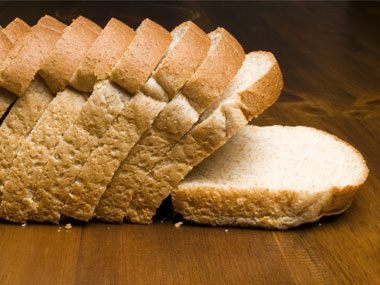
white loaf of breadiStock/Thinkstock
30. Avoid white foods.
There is some scientific legitimacy to today’s lower-carb diets: Large amounts of simple carbohydrates from white flour and added sugar can wreak havoc on your blood sugar and lead to weight gain. While avoiding sugar, white rice, and white flour, however, you should eat plenty of whole-grain breads and brown rice. One Harvard study of 74,000 women found that those who ate more than two daily servings of whole grains were 49 percent less likely to be overweight than those who ate the white stuff.
31. Switch to ordinary coffee.
Fancy coffee drinks from trendy coffee joints often pack several hundred calories, thanks to whole milk, whipped cream, sugar, and sugary syrups. A cup of regular coffee with skim milk has just a small fraction of those calories. And when brewed with good beans, it tastes just as great. You can also try nonfat powdered milk in coffee. You’ll get the nutritional benefits of skim milk, which is high in calcium and low in calories. And, because the water has been removed, powdered milk doesn’t dilute the coffee the way skim milk does.
32. If you’re going to indulge, choose fat-releasing foods.
They should help keep you from feeling deprived and binging on higher-calorie foods. For instance: honey has just 64 fat releasing calories in one tablespoon. Eggs have just 70 calories in one hard-boiled egg, loaded with fat releasing protein. Part-skim ricotta cheese has just 39 calories in one ounce, packed with fat releasing calcium. Dark chocolate has about 168 calories in a one-ounce square, but it’s packed with fat releasers. And a University of Tennessee study found that people who cut 500 calories a day and ate yogurt three times a day for 12 weeks lost more weight and body fat than a group that only cut the calories. The researchers concluded that the calcium in low-fat dairy foods triggers a hormonal response that inhibits the body’s production of fat cells and boosts the breakdown of fat.
33. Enjoy high-calorie treats as the accent, not the centerpiece
Make a spoonful of ice cream the jewel and a bowl of fruit the crown. Cut down on the chips by pairing each bite with lots of chunky, filling fresh salsa, suggests Jeff Novick, director of nutrition at the Pritikin Longevity Center & Spa in Florida. Balance a little cheese with a lot of fruit or salad.

Fiber in CerealiStockphoto/Thinkstock
34. Eat cereal for breakfast five days a week.
Studies find that people who eat cereal for breakfast every day are significantly less likely to be obese and have diabetes than those who don’t. They also consume more fiber and calcium—and less fat—than those who eat other breakfast foods. Make oatmeal, or pour out a high-fiber, low-sugar cereal like Total or Grape Nuts.
35. Try hot sauce, salsa, and Cajun seasonings
They provide lots of flavor with no fat and few calories, plus they turn up your digestive fires, causing your body to temporarily burn more calories. Choose them over butter and creamy or sugary sauces.
36. Eat fruit instead of drinking fruit juice.
For the calories in one kid-size box of apple juice, you can enjoy an apple, orange, and a slice of watermelon. These whole foods will keep you satisfied much longer than that box of apple juice, so you’ll eat less overall.
37. Drop your milk type and you cut calories by about 20 percent.
If you drink regular, go to 2%. If you already drink 2%, go down another notch to 1% or skim milk. Each step downward cuts the calories by about 20 percent. Once you train your taste buds to enjoy skim milk, you’ll have cut the calories in the whole milk by about half and trimmed the fat by more than 95 percent.
38. Snack on a small handful of nuts.
Studies have found that overweight people who ate a moderate-fat diet containing almonds lost more weight than a control group that didn’t eat nuts. Snacking once or twice a day helps stave off hunger and keeps your metabolism stoked. You can also pack up baby carrots or your own trail mix with nuts, raisins, seeds, and dried fruit.
39. Get most of your calories before noon.
Studies find that the more you eat in the morning, the less you’ll eat in the evening. And you have more opportunities to burn off those early-day calories than you do to burn off dinner calories.
40. Brush your teeth after every meal, especially dinner.
That clean, minty freshness will serve as a cue to your body and brain that mealtime is over.



Read more: http://www.rd.com/health/diet-weight-loss/how-to-lose-weight/#ixzz3RwBa8BTx

Τρίτη 10 Φεβρουαρίου 2015

Six beautiful and bizarre bridges


Transformative function in Germany
In their most basic form, bridges help people get from point A to point B. Yet sometimes – like in the case of the Rakotz bridge in Kromlau, Germany (pictured) – the structure can transform the very landscape around it and become a work of art.
We went looking for some of the world’s most beautiful bridgesand found plenty of nominations from users on the question-and-answer site Quora.com. Here are a few of their selections, remarkable for their physical beauty, architectural ingenuity and harmony with their surroundings. 


Spanning the sky in Malaysia
Architect Mayur Kanaiya gave special props to the Langkawi Sky Bridge, a 125m-long curving cable bridge atop Gunung Mat Cincang mountain on Pulau Langkawi island. “The curving bridge deck allows visitors an intimate experience of the forest canopy and wildlife,” said Kanaiya. “It’s a great example of treading lightly on the land.”


A natural wonder in India
Instead of bricks, mortar or even standard planks of wood, the village of Cherrapunji in the state of Meghalaya – known as one of the wettest places in the world – builds bridges out of tree roots. The local War-Khasis tribe learned long ago how to tame the roots of the native ficus to grow in a certain direction, using bamboo as support. Some of the bridges are more than 30m long and can support the weight of 50 people, said Ravi Kodakandla, a Quora user from Hyderabad, India. 


Going below ground in the Netherlands
While most bridges cross above water, the sunken bridge at Fort de Roovere near the village of Halsteren sinks just below it. Architecture student Wu Zhuoyi nominated the bridge because it takes visitors through a moat. The walls function like a dam to keep the water out and the structure blends seamlessly with its surroundings, remaining invisible from a distance. 


Acrobatics on display in London
Forget the drawbridge. In London, the 12m-long Rolling Bridge curls to one side to let boats through the Grand Union Canal at Paddington Basin. “Its eight steel and timber hinged sections will curl up until the two ends of the bridge meet, forming an octagonal shape,” said Koen Kas, an entrepreneur from Belgium. “Every Friday at noon, the bridge performs its acrobatics for admiring crowds.” 


The tenacity of mankind in Yemen
Mechanical engineer Achilleas Vortselas had a special affection for stone bridges. “No modern bridge can compare in grace with traditional stone arch bridges,” he said. “Stone bridges often demonstrate the tenacity of mankind to overcome physical obstacles, even with modest technical means. Shaharah Bridge in Yemen is a marvellous case of that.”

Seven unknown architectural wonders

To uncover a few of those hidden structures, we turned to question-and-answer site Quora, asking “What are some lesser known architectural landmarks in the world?”
Palace of the Parliament, Romania
The world’s largest, most expensive and heaviest civilian administrative building, Bucharest’s Palace of the Parliamentis truly an unknown wonder. “Built by hated communist dictator Nicolae Ceausescu… the building is so huge that it is difficult to take a photograph that does its scale justice,” said Quora user Jann Hoke, a lawyer who worked in the palace in the mid-1990s.
Bucharest Palace, Quora, Husna Haq
The Palace of the Parliament in Bucharest, Romania has some 3,100 rooms covering 330,000sqm. (Thinkstock)
Built in 1984, the neoclassical building has 12 stories (with eight additional stories underground), and some 3,100 rooms covering 330,000 sqm. The project cost an unprecedented 3.3bn euros, but it also cost the people of Bucharest much of their city. To build the Palace of the Parliament, one-fifth of central Bucharest was razed, including most of its historical districts, more than 30 churches and synagogues and some 30,000 homes.
“The patterned carpets on the main level, which run through hundreds of yards of wide corridors, were woven inside the building during construction,” Hoke said. “Weaving them outside and bringing them in was not feasible due to their sheer size.”
Great Mosque of Djenne, Mali
Built in 1907, the Great Mosque of Djenne is the largest mud structure in the world, constructed almost entirely of sun-baked earthen bricks, sand and a mud-based mortar and plaster. It is considered one of the greatest achievements of the Sudano-Sahelian architectural style and was designated a Unesco World Heritage Site in 1988.
Mali, Great Mosque of Djenne, Quora
The Great Mosque of Djenne, in the Niger Delta region in central Mali. (Francois Xavier Marit/Getty)
The mosque’s three minarets are decorated with bundles of rodier palm, which double as scaffolding for the annual repairs – a tradition that’s become a local festival in April and May.
“The brutal North African summers bring out cracks in the mud and weaken it over time,” said Quora user Abishek Lamba. “Before the yearly rains that follow, the locals get together and re-coat the entire building with clay from a dried up pond.”
Derawar Fort, Pakistan
A fortress of monumental proportions, Derawar’s 40 stunning bastions rise from the desert in a striking square formation. Combined, the fort’s walls form a circumference of some 1,500m and stand some 30m high.
Derawar Fort, Pakistan, Quora
To visit the Derawar Fort, visitors must hire a guide with a four-wheel drive vehicle and make the daylong trip through the Cholistan Desert. (Nadeem Khawar/Getty)
“This is a magnificent structure in the middle of the Cholistan Desert,” said Quora user Faisal Khan. “Many people don't know about the Derawar Fort. Even most Pakistanis don't know of it.”
And for good reason: to get to the fortress, visitors must hire a guide with a four-wheel drive vehicle to make the day-long trip from the city of Bahawalpur, Pakistan through the Cholistan Desert to the fort, where special permission from the amir, or local leader, is needed to go inside.
Chand Baori, India
One of the most overlooked landmarks in India, Rajasthan’s Chand Baori is a spectacular square stepwell, 13 storeys deep, with walls lined with scores of double staircases that descend some 30m to the bottom of the well, where a pool of emerald green water awaits.
Chand Baori, India, Quora
The symmetrical steps of Rajasthan’s Chand Baori stepwell make a mesmerizing maze. (Thinkstock)
The mesmerising maze of symmetrical steps “appears to form a never ending path deep underground,” said Quora user Vipul Yadav. With its 3,500 steps, Chand Baori is “one of the deepest and largest of its kind in the world”.
Built by King Chanda of the Nikumbha Dynasty between 800 and 900 AD, Chand Baori was designed to be as practical as it was pretty. Due to the structure of the well, the bottom of it remains cooler than the surface, critical in the hot, arid landscape of Rajasthan.
Stari Most, Bosnia-Herzegovina
If every great architectural landmark has a story, Bosnia-Herzegovina ‘s Stari Most has a comeback story.
“The Old Bridge, or Stari Most as it's called by locals, was built of 456 blocks of local stone in 1566 by the Ottoman Turkish architect, Mimar Hajrudin,” said Quora user Haris Custo. “It was the heart of our city for 427 years.”
Bosnia, Stari Most, bridge
A diver tests his bravery by diving off Bosnia’s Stari Most into the icy waters of the Neretva River below. (Getty)
The hump-backed bridge is located in the city of Mostar, where it crosses the Neretva River. At 4m wide, 30m long and 24m high, it is one of the country’s most recognisable landmarks and is one of the finest examples of Islamic architecture in the Balkans.
But in the 1990s, the bridge was destroyed by Bosnian Serb and Croat forces during the Bosnian war. After the war, the city – and the bridge – began rebuilding. “It took almost 10 years to make that idea come to life, and in July of 2004 a new ‘old bridge’ was open again,” Custo said.
While the bridge has changed since its reconstruction, one long-time tradition remains: locals still dive off the bridge into the icy waters of the Neretva to show off their bravery and skill.
Great Wall of India
“
We have all heard of the Great Wall of China, but few know that India also has its own Great Wall, which has been long overshadowed by its neighbour to the East,” said Quora user Ayush Manu.
The Great Wall of India, also referred to as Kumbhalgarh, is the second-longest wall in the world, after the Great Wall of China. Located in Rajasthan, the wall is 4.5m thick in some areas, extends for 36km and has seven fortified gates.
The Great Wall of India, Kumbhalgarh, Quora
The Great Wall of India, or Kumbhalgarh, remains an unknown treasure to most of the world. (Thinkstock/Franck Camhi)
Rana Kumbha, a local ruler, commissioned the wall in 1443 to protect his fort, situated on a hill above.
“Legend has it that despite several attempts, the wall could not be completed,” Manu said. “Finally the king consulted one of his spiritual advisers and was advised that a sacrifice be made, and a volunteer offered his life so that others will be protected. Today, the main gate stands where his body fell and a temple where his severed head came to rest.”
The wall was enlarged in the 19th Century and now protects more than 360 temples located within its walls, but it remains an unknown treasure to most of the world.
Sheikh Lotfollah Mosque, Iran
Quora user Mona Khatam described the Sheikh Lotfollah Mosque – an architectural masterpiece of Safavid Iranian architecture – as “a study in harmonious understatement”.
Located in Naghsh-i Jahan Square in the city of Isfahan, the stunningly elegant mosque was built between 1603 and 1619 during the reign of Shah Abbas I. It is named after the ruler’s father-in-law, Sheikh Lotfollah, a revered Lebanese scholar of Islam.
Sheikh Lotfollah Mosque, Iran, Isfahan
Iran's Sheikh Lotfollah Mosque is “a study in harmonious understatement”, said Quora user Mona Khatam. (Thinkstock)
The mosque is unusual in that it features no minarets or courtyard. “This was probably because the mosque was never intended for public use, but rather served as the worship place for the women of the shah’s harem,” Khatam said.
As such, the prayer hall is reached through a long, twisting, underground hallway, and the decoration on the mosque is extraordinarily exquisite.
“The dome makes extensive use of delicate tiles that change colour throughout the day, from cream to pink,” said Khatam. “Inside the sanctuary you can marvel at the complexity of the mosaics that adorn the walls and the extraordinarily beautiful ceiling, with its shrinking, yellow motifs. The shafts of sunlight that filter in through the few high, latticed windows produce a constantly changing interplay of light and shadow.”

Σάββατο 7 Φεβρουαρίου 2015

Mysteries of the Ancient World

For all of the time we spend researching and documenting our past, there are still many questions left unanswered. Our ancestors left a lot of traces in this world, and not all of them were ever meant to be understood by other cultures. Despite our best efforts, they remain mysteries to this day.

10The Paracas Candelabra


Candelabra

Geoglyphs are giant images drawn on the surface of the ground. The Nazca Lines are probably the most famous geoglyph, but just 200 kilometers (130 mi) from the Nazca Plain is an even more mysterious example.
The Paracas Candelabra measures about 180 meters (600 ft) across. Despite the close proximity to the Nazca Lines, this geoglyph was likely not built by the Nazca people. Ancient pottery found at the site dates to 200 B.C., which means that theParacas culture is most likely responsible. But while we have some idea who built the candelabra and when, the question of why leaves archaeologists baffled.
Some attribute a religious value to the geoglyph, as locals consider it to be the staff of Viracocha, an ancient creator god. Others, however, suggest a more practical purpose. The Candelabra is carved into a hill. The angle and huge size means that it can be seen from a great distance, as far as 20 kilometers (12 mi) out to sea. This has led some to believe that it was used as a landmark for sailors.

9The Uffington White Horse


Ancient and mysterious landmarks are not an uncommon sight in England. Although Stonehenge comes to mind first, many more are to be found.
The White Horse in Uffington, a 115-meter (374 ft) hill figure, was created by digging deep trenches filled with crushed chalk. This animal appears to be a horse, and similar depictions appear on ancient coins dated to the Bronze Age. Near the figure are burial mounds from the Neolithic period.These graves were reused up until the Saxon period, leading some to claim that the White Horse is not as old as previously thought.
Two factors separate the Uffington White Horse from similar landmarks. For starters, the White Horse is much, much older. Many other horse figures date to as late as the 18th century, so they were most likely done in honor of the original White Horse. The other factor is the condition of the figure. Considering how old it is, the White Horse is in remarkable shape, most likely thanks to the locals who kept it in good repair.

8The Liber Linteus Zagrabiensis

03
Photo credit: SpeedyGonsales/Wikimedia
The Linen Book of Zagreb is the longest text written in the Etruscan language. The language had a huge impact on the world since it heavily influenced Latin, but nowadays, it is mostly lost. Only a few ancient documents feature it, so large chunks of the Liber Linteus are still untranslated to this day. From what can be gathered from the book, it appears to be a ritual calendar, although it was initially thought to detail funeral rituals.
It’s astonishing that the Liber Linteus survived all this time despite being from the third century B.C. It is extremely uncommon for linen books to last that long—but the Liber Linteus was no ordinary book. It survived because it was repurposed. The book was cut into pieces and used by ancient Egyptians to wrap a mummy.
This meant that the Liber Linteus was preserved in good condition, but it went unstudied for a long period of time. Even when it was found, most people who saw it simply assumed that the text was Egyptian.

7White Shaman Rock

04
Photo credit: National Parks Service
The ancient cultures of the Americas still hold many secrets, and one way to decode them is by studying rock paintings. Near the Pecos River in Texas’s Lower Pecos Canyon is one of the oldest and most significant of these paintings—the White Shaman. A 7-meter (24 ft) artwork dated to over 4,000 years ago, the White Shaman is thought to offer information regarding an ancient lost religion.
Controversy surrounds the rock painting’s meaning. Up until recently, most archaeologists agreed that the artwork depicted five human figures in battle or during a pre-battle ritual. However, one archaeologist now claims it shows people communicating with the spirit world, specifically through the use of peyote.

6The Sajama Lines

05
Anyone impressed with the Nazca Lines or the Paracas Candelabra should learn about the Sajama Lines in Bolivia. They, too, are a collection of lines etched into the ground, but they dwarf other geoglyphs in sheer scope.
Sajama has thousands, maybe even tens of thousands of different lines that range from 1–3 meters (3–10 ft) in width and can be up to 18 kilometers (11 mi) in length. The lines cover an area of almost 7,500 square meters (70,000 sq ft)—roughly 15 times larger than the famous Nazca Lines. Despite their giant scale, very little research has been done regarding the Sajama Lines. The true size of the network had been very difficult to gauge until recently, when satellite imagery became available.
The lines are astonishingly straight despite their length, natural obstacles, and the area’s rugged topography. No records detail the lines’ construction, but they are most likely prehistoric, built over countless generations.
Their purpose remains a mystery. They may have guided pilgrims, they may have marked burial towers, or they may have had some sort of astronomical significance.

5The Tartaria Tablets


These three small stone tablets, found in a Romanian village, might feature the earliest form of writing ever discovered.
Most archaeologists used to agree that several regions developed writing independently between 3500 and 3100 B.C. The earliest examples we could find showed photo-writing from cultures such as the Sumerians in Mesopotamia. However, if the Tartaria tablets are genuine, then theypredate the other discoveries by 2,000 years.
In that case, the earliest writing belongs to the Vinca civilization, a Neolithic culture present throughout southeastern Europe between 5500 and 4500 B.C. Various other artifacts from that era belonging to the Vinca culture have been found, also with symbols on them.
The mystery regarding the tablets comes from their age. Initially, museum employees baked the clay tablets to better preserve them. The process rendered accurate carbon dating impossible. So at first, they appeared to be from around 2700 B.C. Only recently have newer tests suggested that they are much older.

4The Blythe Geoglyphs

07
Photo credit: Ron Gilbert
The Blythe Intaglios are a collection of dozens of geoglyphs found in the Colorado Desert near Blythe, California. They show various representations of animals, geometric shapes, and giant humans, the largest depicting a 50-meter (170 ft) man. The true scope of the geoglyphs was unknown until 1932, when it was viewed from the air.
Based on their location, they were likely constructed by the Quechan or Mojave Indians. The etchings are supposed to represent important figures from these respective cultures. Two, for instance, are thought to represent Mastamho and Kataar, two creator deities found in Mojave culture.
But we still know remarkably little about the carvings for certain. They could have been made as long as 10,000 years ago or as recently as 450 years ago.

3The Death Of Alexander The Great

08
Even though Alexander the Great is one of the most famous and most well-documented figures of the ancient world, a lot of mystery surrounds his death. Most experts agree on the time and place—June 10, 323 B.C. at the palace of Nebuchadnezzar II in Babylon. The cause of death, however, remains far from certain.
For a long time, we thought Alexander was poisoned. Viable suspects abounded—his generals, his wife, his half-brother, and more. All we know for certain is that Alexander fell ill suddenly and spent two weeks in bed with a high fever and abdominal pains before dying.
Yet his death may have been the result of an illness instead of foul play. This still leaves many potential candidates to explain the symptoms: viral hepatitis, pancreatitis, endocarditis, or maybe something else altogether. Recent theories also suggest that he could have been the victim of an infectious disease like typhoid or malaria.
Even more mysterious is how his death was foretold by the Chaldeans, who warned him he would die if he entered Babylon. Not only that, but Calanus, an Indian philosopher who accompanied Alexander’s army, told the young conqueror on his own deathbed that the two would meet again in Babylon (this at a time when the army was headed nowhere near the city).

2The Minaret Of Jam


The Minaret of Jam in Afghanistan is admired by many for its beauty and complex design. The 64-meter (210 ft) tower is still in good condition today, even though it was built sometime in the 12th or 13th century using baked bricks. The intricate decorations and inscriptions are still clearly visible. This alone was enough to get it declared a UNESCO World Heritage Site.
The unknown date of the minaret’s construction makes its purpose a unclear. An inscription notes when it was built, but it cannot be read with certainty. We just know the tower was built by theGhorid Dynasty at the height of its glory, when it ruled over parts of modern Iran, Pakistan, Afghanistan, and India.
The most intriguing theory regarding the Minaret of Jam is that it might have belonged to the lost city of Firozkoh. Also known as the Turquoise Mountain, the city was the capital of the Ghorid Dynasty and one of the greatest cities in the world. But it was completely destroyed by Ogedei Khan, son of Genghis, and its location was forever lost.

1The Emerald Tablet

10
The Emerald Tablet remains the most mysterious item on this list because, unlike the others, it does not exist anymore. We do not know its author, origin, or location. We do not even know exactly what it looked like.
All we know is that the first documented mention of the Emerald Tablet dates to an old Arabic book sometime between the sixth and eighth centuries. The earliest Arabic translations claim that the original text was in ancient Syriac. The first Latin translation of the text appeared in the 12th century, and multiple other translations have been made since then (including one by Sir Isaac Newton).
The text is considered the most important document in the field of alchemy. It is prized by alchemists because it supposedly presents information regarding the philosopher’s stone, a substance able to turn base metals into gold. But despite allegedly holding such valuable information, nobody has ever successfully used the Emerald Tablet to achieve that alchemical feat.